Monday, October 8, 2018

GVA Finance

GVA Corporate Finance, actually. GVA Finance would have to include noncorporate financial business, which would make the number bigger. But three extra syllables weigh me down and slow me down.

Can't have that. I'm slow enough as is, at top speed.


Remember the "output gap"? It looked like this:

Graph #1 Source: Mother Jones, 16 March 2012
If you still don't remember, go read Kevin Drum.

Anyhow, I just now found a similar-looking gap in Finance: in GVA Corporate Finance.

Remember when it used to be "FI!-nance"? Then a commercial came on TV and changed it to "fuh-NANCE!". A softer, gentler name, to make us love finance. Screw that. They don't need our love. They have our money.

And you thought the government had your money, you silly boy.

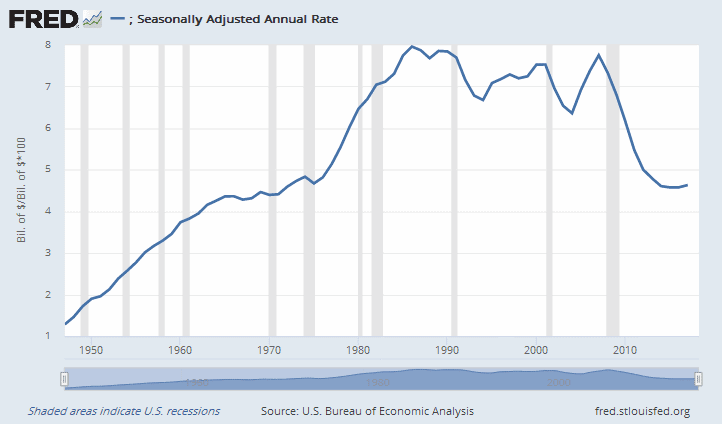
Graph #2: GVA Finance Falls Behind Trend after 2006
I see a straight-line trend of increase since the end of the second World War. Sudden drop there, just before the 2009 recession. And after that, GVA Finance runs below trend, showing a gap that looks a lot like the output gap.

Couple things are different, though. Since 2009, GVA Finance has climbed back up toward trend. Yes, real GDP has also moved closer to trend, but that is because they kept moving the "trend line" down to bring it closer to actual GDP.

Yeah, they did:

Graph #3 Source: Center on Budget and Policy Priorities, 31 Jan 2018
It would be like taking the dashed line on Graph #2 and tipping it down to bring it closer to the actual numbers. And no, you wouldn't call that "cheating". You'd just call it a "revision". Winston Smith could tell you all about it.

But there is something else about the trend of GVA Finance. As Bezemer & Hudson put it:
National accounts have been recast since the 1980s to present the financial and real estate sectors as “productive”.
"National accounts have been recast". That must be a good portion of what the "revisions" have been about. And then the "base year" is changed, too, which makes it more difficult to compare the new and old data to see how much GDP went up due to the recasting.

I quote now from The Financialization of GDP: Implications for Economic Theory and Policy by Jacob Assa. From the Foreword by Brett Christophers:
The idea that contemporary capitalism represents a form of financialized capitalism is problematic, Assa maintains, because the statistical measure most commonly employed to demonstrate such financialization -- gross domestic product, of which finance is estimated to have accounted for an increasing proportional quantum -- has itself been financialized. Hence: "the financialization of GDP."

But what does Assa mean by this? What he means is that the way in which GDP is calculated has been changed in recent decades in such a way as to boost the relative contribution to GDP that the financial sector is seen to make, regardless of any actual transformation in the underlying economy...

His most distinctive contribution in this book ... is to at once recognize the problematic nature of the existing statistical framing and to suggest an alternative approach to GDP measurement...

Assa's preferred metric -- final GDP (FGDP) -- treats financial activities not as a positive economic output ... but instead as an intermediate input -- and thus as a net cost to the wider economy.
Yes! And thank God someone has finally said it. Finance is a cost. But those damn revisions take more and more of the bits and pieces of finance and choose to see them not as something that subtracts from GDP, but as something that adds to it.

It pushes GDP up. It pushes finance up. And according to Jacob Assa and Brett Christophers, and Dirk Bezemer and Michael Hudson, it is one of the reasons that finance has grown as a share of GDP: One of the reasons the line goes up on Graph #2.

And then, there is another difference: Graphs of the output gap compare a tally to its trend. My graph of the GVA Finance gap compares a ratio to its trend.

Only two things can change the output gap: changes in GDP, or fiddling with the trend. But three things can change the GVA Finance gap: changes in finance, changes in GDP, or fiddling with the trend.

GDP didn't go up relative to trend until they fiddled with the trend. Finance has been going up relative to GDP, because they fiddled with the actual values.


I'm not sure what-all they count as "finance". I know it gets revised too often, but what they include I couldn't say. But I know what I see as the main cost of finance: the cost of interest. Not the rate of interest, but the amount we pay in dollars to service the interest we owe. FRED has a data series for that, called "Monetary Interest Paid". I put it on a graph along with "Gross value added of financial corporate business" in billions:

Graph #4
Red is interest paid; blue is GVA of Financial Corporations, in Billions. After 1970 or so it is easy to see that GVA is a good chunk of interest paid. How big a chunk?

Graph #5: GVA Finance as a Percent of Monetary Interest Paid
GVA Finance was near 38% of Interest Paid in 1960. It fell below 16% in 1981. And it has been generally showing increase since then, reaching above 54% in 2015. If you just look at it as "downtrend to 1981 and uptrend since" it runs opposite interest rates.

Turn that ratio upside-down, and it tends to follow interest rates:

Graph #6: Showing the Similarity of Interest Rates and Interest Paid relative to GVA Finance
It is too similar not to point out. But what does it mean? As Riggs said to Murtaugh, probably nothing.

Or idunno, you tell me.

Sunday, October 7, 2018

"Keynesianism + the theory of growth = The New Economics"

Some quotes:

How soon will normal business enterprise come to the rescue? What measures can be taken to hasten the return of normal enterprise? On what scale, by which expedients and for how long is abnormal government expenditure advisable in the meantime?


"What Keynes called for was deficits when the private sector cut back", Kimel says in a comment at Presimetrics, "and surpluses at other times".


Today, some 20 years after his death, his theories are a prime influence on the world's free economies, especially on America's, the richest and most expansionist. In Washington the men who formulate the nation's economic policies have used Keynesian principles not only to avoid the violent cycles of prewar days but to produce a phenomenal economic growth and to achieve remarkably stable prices. In 1965 they skillfully applied Keynes's ideas—together with a number of their own invention—to lift the nation through the fifth, and best, consecutive year of the most sizable, prolonged and widely distributed prosperity in history.

Though Keynes is the figure who looms largest in these recent changes, modern-day economists have naturally expanded and added to his theories, giving birth to a form of neo-Keynesianism. Because he was a creature of his times, Keynes was primarily interested in pulling a Depression-ridden world up to some form of prosperity and stability; today's economists are more concerned about making an already prospering economy grow still further. As Keynes might have put it: Keynesianism + the theory of growth = The New Economics.

Keynesianism made its biggest breakthrough under John Kennedy, who, as Arthur Schlesinger reports in A Thousand Days, "was unquestionably the first Keynesian President." Kennedy's economists, led by Chief Economic Adviser Walter Heller, presided over the birth of the New Economics as a practical policy and set out to add a new dimension to Keynesianism. They began to use Keynes's theories as a basis not only for correcting the 1960 recession, which prematurely arrived only two years after the 1957-58 recession, but also to spur an expanding economy to still faster growth.


See also: Moments in Time

Saturday, October 6, 2018

Demand Deposits relative to Total Credit Market Debt

Demand deposits, that's the money we spend when we're not using credit cards. Basically. Except for the greenbacks in your pocket.


"Demand Deposits" is the money we use when we pay the bills. "Total Credit Market Debt", that's the bills we have to pay.

Friday, October 5, 2018

Menzie shows some graphs

Here.

Including these two:

Figure 4: Household debt rose in crisis countries

Figure 5: But not in non-crisis countries

Figures 4 and 5, with Menzie's captions.

Thursday, October 4, 2018

"Consensus Assignment"

Begin with an observation by Simon Wren-Lewis:
[The] consensus assignment [1] is that interest rates should be used to stabilise the economy rather than fiscal policy. The whole idea of independent central banks setting interest rates is predicated on this assignment.
Use interest rates to stabilize the economy, and fiscal policy for other things: This is the Consensus Assignment. Then, a powerful thought: "The whole idea of independent central banks setting interest rates is predicated on this assignment."

Simon's footnote reads
[1] The term assignment comes from the idea that you have two instruments that can control inflation, fiscal policy or interest rates, and an assignment is where only one instrument is used to do the job. You could use both, of course, but if each instrument is controlled by different people with different views about the economy obvious problems could arise. Also in simple New Keynesian models it is optimal just to use monetary policy. I use the term conventional or consensus because it is the assignment that pretty well all advanced countries use, and the one most mainstream academic macroeconomists would recommend.
Pretty well all advanced countries use interest rates to stabilize the economy, and fiscal policy for other things.

In an older post Wren-Lewis says
Inflation targeting by central banks involves an attempt to manage the economy in much the same way as Keynesian fiscal activism had done before.
That sentence shines light on a change in the "consensus assignment" and gives me a better feel for what the term means. In that post also, Wren-Lewis describes the consensus assignment as "monetary to demand management, fiscal to debt control".

As Simon puts it, we rely on central banks to "stabilize the economy" or "manage" demand. But you can't push on a string. So the management is one-sided: It can reduce growth, but it cannot increase growth. (It can allow growth to increase, but cannot force growth to increase.) So you really don't have "management" of demand. All you have is attenuation:

Attenuation of Demand since the 1980s
The high points on the graph are generally lower after 1983 than before. That's attenuation.

Also, the lows are generally higher after 1983. This probably means that the growth that was cut off the top came back later to fill in the lows at the bottom. Demand was postponed from a time of high growth to a time of low growth. That's pretty interesting. It could account for the reduced volatility described by the words "the great moderation".

That seems right. Average growth during the Great Moderation was a little lower than in the years before. You would expect average growth to be a little lower, if your method of management is to postpone growth.

I would say that the higher lows since the 1980s were not so much policy as the economy's response when "demand management" relented in its battle against inflation. As the 2009 recession shows, however, attenuating the highs does not give you control over the lows. You can allow growth to increase, but you cannot force it. You can't push on a string.

By the way, Wren-Lewis is not defending the "monetary to demand management, fiscal to debt control" consensus assignment. He says it's dead. If so, we probably need a new match-up of policy instruments and economic objectives.


In his "Consensus Assignment is dead" post, Wren-Lewis quotes Martin Sandbu:
Besides, there was broadly shared understanding among macroeconomists and central bankers of the best division of labour. Fiscal and budgetary policy should be set to achieve microeconomic and distributive goals, and the desired share of the state in the economy; while monetary policy should take care of stabilising aggregate demand.
Division of labor. Wren-Lewis replies:
This is what I call the Consensus Assignment, and as the name implies it was certainly the consensus among mainstream macroeconomists before the 1990s. But the experience of Japan’s lost decade where they also had interest rates stuck at the ELB began a process of rethinking. By the time the GFC came around many macroeconomists had realised that there was an Achilles Heel in the Consensus Assignment. Fiscal stabilisation was still required when interest rates hit their ELB. That is why we had fiscal stimulus in 2009.
Here again we find monetary policy attenuating demand. Fiscal, Sandbu says, is used to manage the shape and the size of the economy. Wren-Lewis reduces this to a single sore point: "fiscal to debt control". I would say "fiscal to economic growth" -- to the shape and size of the economy.

Similarly, I would reduce "monetary to demand management" to "monetary to inflation control".


From JW Mason:
An increasingly visible school of heterodox macroeconomics, Modern Monetary Theory (MMT), makes the case for functional finance—the view that governments should set their fiscal position at whatever level is consistent with price stability and full employment, regardless of current debt or deficits.
Fiscal to inflation control, monetary to debt control. The opposite of the consensus assignment described by Simon Wren-Lewis. Mason continues:
Functional finance is widely understood, by both supporters and opponents, as a departure from orthodox macroeconomics. We argue that this perception is mistaken: While MMT’s policy proposals are unorthodox, the analysis underlying them is largely orthodox. A central bank able to control domestic interest rates is a sufficient condition to allow a government to freely pursue countercyclical fiscal policy with no danger of a runaway increase in the debt ratio.
Central banks using interest rates for debt control: again, the opposite of the assignment described by Wren-Lewis.

Mason continues:
The difference between MMT and orthodox policy can be thought of as a different assignment of the two instruments of fiscal position and interest rate to the two targets of price stability and debt stability.
Mason describes it as a different assignment of the two instruments to the two targets. Here he is using Wren-Lewis's "consensus assignment" concept and terminology as a framework to describe the way economic policy is used.

That is fascinating, I think. And useful: It helps me see the assignments as assignments rather than as economic laws. Simon points out that the consensus assignments are widely accepted by policy economists in "pretty well all advanced countries" and by "most mainstream academic macroeconomists". That may make changing the assignments difficult. But it doesn't make them laws.


From me, from a long time ago, my own view of what the assignments are and the problem with that arrangement:

Government has two tools to make an economy work: monetary policy, and fiscal policy...
Where I use the word "tools" Simon Wren-Lewis says "instruments". Two tools of policy, I say. Two instruments of policy, he says. But we do agree on what those tools (or instruments) are.

The rest of that thought is all mine:
Government has two tools to make an economy work: monetary policy, and fiscal policy. But our national policy decisions combine these policies badly. Monetary policy has been at odds with fiscal policy since the end of World War II.

The problems in our economy today are a result of our conflicting policies. In order to repair our economy, it will be necessary to make the policies cooperate. If you know how the policies work and how they conflict, then you will know what must be done.

Fiscal policy is often called "tax and spend" policy. We think of it as something that the government wants more of, while we want less. But there is more to it than that. Taxes are used in many ways to encourage economic growth. Tax policy encourages business spending in order to boost economic activity and boost incomes. Fiscal policy is a highly effective way to stimulate the economy.
Fiscal to economic growth.
Monetary policy takes money out of circulation in an attempt to reduce inflation...
Monetary to inflation control.

Takes money out of circulation... Or raises interest rates to reduce the growth of borrowing and reduce the pace at which bank money is being added to the economy. Say it however you want. It still comes down to reducing the growth of the quantity of money. It still comes down to taking money out of circulation.
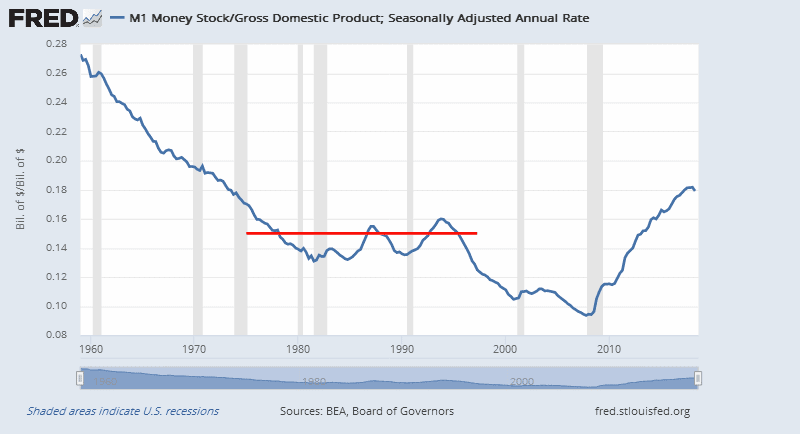
Monetary policy takes money out of circulation in an attempt to reduce inflation. While our economy has grown over the last half century, the money supply has dwindled from 50 cents to 15 cents per dollar's worth of output. That decrease is the result of the monetary policy actions against inflation. We have created a nation of customers without money.
The quantity of money hung in the neighborhood of 15 cents (per dollar of output) from the mid-70s to the mid-90s. I could have written those words at any time during those years. (I did.)

Since the mid-90s the quantity of M1 money continued to dwindle, falling below ten cents per dollar of output shortly before the GFC, no doubt contributing to it.

Since 2008 the ratio has been rising. To restore the economy, the central bank reversed the trend. It is now above 16 cents. But it is not enough: We still have too much debt, public and private. We need less debt and more money per dollar of GDP.

Note that increasing the quantity of government money is not inflationary if we compensate by reducing the quantity of money created by private lending. In other words, "less debt" is a way to fight inflation.

Monetary policy can only achieve less debt by raising interest rates, so that new additions to borrowing are reduced. But that means new additions to GDP are also reduced: Raising interest rates is bad for growth.

Why not change the assignments, and use fiscal policy to fight inflation? We can establish variable tax rates that encourage the repayment of debt (so you can reduce your taxes by making extra payments on your debt). This approach gives us "less debt" by reducing existing debt. The central bank can keep interest rates low to encourage borrowing, to encourage economic growth. We can grow the economy and fight inflation at the same time, up to the point of full employment of resources.

Fiscal to inflation control. Monetary to economic growth.
On the one hand, monetary policy takes money out of circulation in order to limit spending. On the other hand, tax policy does everything possible to make our spending grow. As a direct result of these policies, we have less money but our spending has increased anyway. We have made up the difference by increasing our use of credit. And that has produced a tremendous accumulation of debt.

My evaluation of the conventional assignments:
  • Fiscal to economic growth
  • Monetary to inflation control
My evaluation is essentially the same as that of Simon Wren-Lewis, Martin Sandbu, and JW Mason.

Sandbu offers it as the current state. Wren-Lewis says no-no, that consensus is now dead (though this, it seems to me, is largely wishful thinking). Mason and Jayadev offer it as the orthodox consensus; they compare and contrast it with a heterodox view. I propose a reversal of the assigments, because our policies as they stand undermine each other.

Wednesday, October 3, 2018

The cost of finance is the extra cost

The cost of finance is the problem. That was my conclusion in yesterday's post. Naked assertion. So today we take a shot at documenting it. Let's look at the total cost of interest paid by households, as a percent of disposable income:

Graph #1: Monetary interest paid: Households/Disposable Personal Income*100
Yeah, don't mind the title of the graph. FRED was having a bad day. I yelled at em.

One percent of disposable income in the late 1940s. One, one and a half percent. But there was straight-line increase to the mid-60s,  followed by a much slower increase. Households already knew, then, that their debt was growing too fast.

But it wasn't that the number was getting big. It was that the cost was rising.

In the 1970s, interest rates went up a lot. The Fed was fighting inflation. Interest cost as a percent of disposable income topped out in the mid-1980s, and started slowly wandering downward. The 1991 and 2001 recessions speeded things up a bit, and the "great" recession speeded things up a lot.

It looks now like it's on the rise again.

//

The cost of interest depends on two things: It depends on the rate of interest, and on the amount of debt we pay interest on. Suppose we take out the rate of interest, and look at what remains.

I'm gonna guess that the average term of a loan is ten years. It's just a guess. Could be less. No matter.

I'll take the ratio shown on the first graph and divide it by a ten-year government interest rate. There are a million different interest rates we could use; I'm using this one. Here's what I get:

Graph #2: (Monetary interest paid: Households/Disposable Personal Income*100)/Long-Term Government Bond Yields: 10-year: Main (Including Benchmark) for the United States
Straight-line increase after 1981.

Look again? Down from 1963 to 1981. Up from 1981 to 2012. Possibly down after 2012, and possibly up before 1963.

Up from 1981 to 2012, reaching five, almost six times the 1981 level. Do we really need this much debt? Is the economy five or six times better now than it was in 1981? Has there been constant improvement, jiggy but constant, since 1981? I don't think so.

//

The cost of finance is like the cost of labor: It is one of the costs that contribute to the total cost of a product. The cost of finance is like the cost of productive capital that way also, except finance is not productive. It facilitates, yes, but it does not produce. But we don't need finance to do so much facilitation. We should have more government money doing more facilitation, so we would need less finance. The way things used to be.

If we cut back on finance, we can expand government money without expanding total money and without causing inflation. It would be easy, if we would do it. And by doing it, we can reduce financial cost to a practical minimum. Less debt, buddy. You love the idea.

Here's the thing. We don't need as much finance as we have. Most of finance, my guess, exists to put extra income in the pockets of the super-wealthy. A good part of it, anyway. Rent, some people call it.

We don't need as much finance as we have. We need more cash (or debit cards, if you prefer) and we need less money on which we pay interest. Maybe you think there is some problem to do that. There is no problem to do that. You just need the people in Congress and the Fed to understand the cost problem created by finance. What they see presently is the other side of that problem, the income generated by finance for themselves and their fat friends.

And I have to say no, the Democrats are no closer to understanding the cost problem than are Republicans.

Tuesday, October 2, 2018

"Prices" versus "Inflation"

Our objectives conflict. We want more growth, but not more inflation. However, when growth goes up, prices go up too. And when growth goes down, prices go down. Or at least that's how it used to work.

These days it's more like this: When growth goes up, inflation goes up; and when growth goes down, inflation goes down. This is not really the same thing, but that doesn't seem to bother anyone.

It should. It should bother you. It is a fundamental change in the way the economy works. But economists and commentators just use the word "inflation" now in place of the word "prices", and proceed as if nothing had changed.

Maybe we should try to figure out why that change occurred. Maybe that would help us understand the economic problem.

//

Here, I'll give you a hint. Instead of going up and down, prices go up more and go up less, but always go up. HINT: There is more cost now, more than there was when prices went up and down. There is more cost now.

What is that cost?

//

Here, I'll give you another hint: The cost of finance.